EN
EN

Sourcing and Qualifying Containers: The Foundation of a Reliable Container House Manufacturer
Evaluating New vs. Used Shipping Containers for Structural Integrity and Compliance
When picking out containers, folks need to check both how sturdy they are and whether they meet all the regulations. Brand new ones come in perfect shape with ISO certification already sorted, but let's be honest, they cost anywhere from 60 to 80 percent more than secondhand alternatives. Secondhand containers require a good eye during inspection though. Look closely for signs of rust spots, weak welds, and damaged floors, particularly important if these containers will go into stacked configurations. No container should ever be considered without proper CSC plates showing it passed safety checks.
Reputable manufacturers prioritize containers with dent depth under 50mm and corrosion limited to Level R (surface rust), in line with ISO 1496-1:2013. Key structural checks include corner post alignment (10mm deviation), roof load capacity (300 kg/m²), and door seal integrity to ensure weather resistance and long-term durability.
Certifications, Traceability, and Sustainability Standards in Container Sourcing
Ethical and compliant sourcing relies on recognized certifications and transparent traceability. Leading manufacturers require ISO 9001 (quality management) and ISO 14001 (environmental compliance) across their supply chains. Blockchain-based material passports are increasingly used to document a container's lifecycle—from manufacture to modification—ensuring alignment with international building codes.
The standards for sustainability these days typically require at least 85 percent recycled steel in construction materials along with non-toxic insulation options. Looking back over recent years, around seventy out of every hundred leading manufacturers of container homes have managed to reach zero waste landfills during their production process, which shows how the industry is moving towards more circular building approaches. Independent groups such as DNV GL have checked this stuff out and found that carbon footprints are actually dropping by more than forty percent when compared against old fashioned building techniques.
Supply Chain Optimization for Container House Manufacturers
Mitigating Cost Volatility Through Strategic Supplier Partnerships
Top manufacturers stabilize costs through long-term contracts with steel suppliers and component fabricators, leveraging volume-based pricing to insulate against quarterly market swings of 15–20%. Collaborative forecasting systems align production schedules with container availability cycles, improving supply predictability.
This integrated approach enabled one national supplier to maintain stable pricing during recent global disruptions, while others faced 34% cost increases. Regular audits ensure all certified partners meet ISO 9001 standards and traceability requirements, maintaining consistent quality across large-scale modular production.
Lean Logistics and Regional Warehousing for Faster Modular Delivery
Efficient delivery networks rely on distributed warehousing within 200 miles of major project sites, reducing final-mile transportation costs by up to 40%. By applying Just-In-Time (JIT) inventory principles, manufacturers minimize onsite storage while achieving 98% on-time delivery rates.
Conversion facilities located near port terminals enable rapid staging, with regional hubs processing up to 50 units per week. Advanced route optimization and GPS-tracked transporters ensure damage-free delivery. These logistics advancements allow turnkey providers to deliver fully equipped homes within 30 days of order confirmation—half the industry average of 60+ days.
From Factory to Site: How Certified Container House Manufacturers Ensure Turnkey Delivery
Integrated Prefab Processes: Engineering, Insulation, and MEP Integration
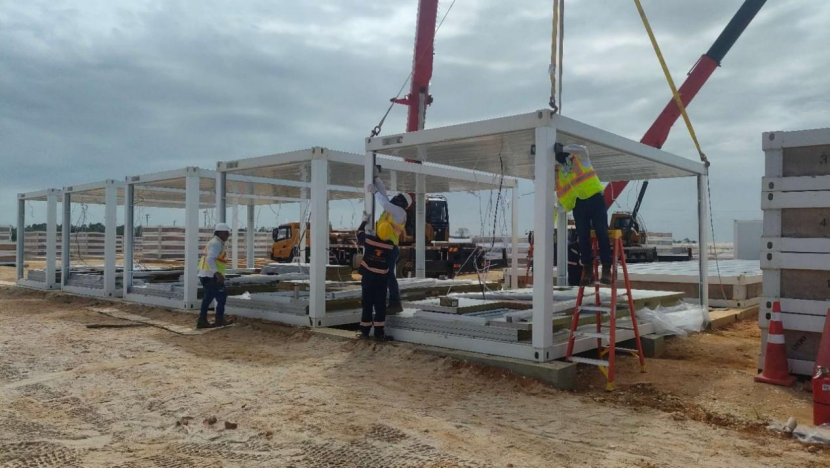
Certified manufacturers streamline construction through integrated prefabrication. Digital modeling optimizes structural load distribution and material efficiency, reducing waste by up to 15% compared to traditional builds. Insulation—using spray foam or mineral wool—is applied in climate-controlled environments to achieve consistent R-values exceeding 5.0 per inch.
MEP systems, which cover mechanical, electrical and plumbing components, get installed through modular parts that are put together offsite. These modules work alongside building information modeling (BIM) tech to avoid clashes when construction actually happens on site. The whole process saves about a third to half of the usual construction time since electricians and plumbers can finish their rough work long before walls go up. Quality control runs throughout every phase too. Plumbers run pressure tests to make sure everything holds water properly while technicians scan buildings with thermal imaging equipment looking for spots where heat might escape through poor insulation. This attention to detail helps catch problems early before they become costly fixes later down the road.
Compliance, Certification, and National Supply Chain Coordination for Scalable Deployment
Turnkey providers enforce strict compliance across all operations. Units meet International Building Code (IBC) standards and carry third-party certifications such as ISO 9001 and LEED for sustainable materials. Components are traceable from source—steel from certified mills, low-VOC finishes from approved vendors—ensuring accountability and performance.
For nationwide deployment, cloud-based platforms coordinate permitting, transport, and site readiness:
- Permitting: Pre-certified designs speed up local approvals
- Transport: Route optimization software reduces transit risks
- Site synchronization: Just-in-time delivery aligns with foundation completion
This integrated model supports the scalable delivery of 500+ units annually while maintaining defect rates below 2%, as confirmed by 2024 modular construction benchmarks.
FAQ
What is the difference between new and used shipping containers?
New shipping containers are in perfect condition and include ISO certification, while used containers require inspection for rust, weak welds, and damage. They are more affordable but need to meet certain regulations and standards.
Why is traceability important in container sourcing?
Traceability ensures that the lifecycle of a container from manufacture to modification is documented and compliant with international building codes, ensuring ethical sourcing and transparency.
How do manufacturers mitigate cost volatility?
Manufacturers use long-term contracts for steel and component suppliers to stabilize costs and employ collaborative forecasting to improve supply predictability.